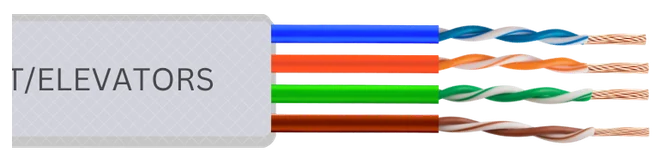
CAT6 flat vs round CAT6 in a lift well
Installers put round CAT6 in lift wells every week. Here is what fails, when, and what to use instead.
Round CAT6 is the cable everyone has on the van, so it is the cable that goes into the lift well when a lift camera is added in a hurry. It works on the day. The problem arrives later, and it arrives at the flex point.
What fails
A round CAT6 cable has four pairs of solid 23 AWG copper inside a rigid PVC or LSZH jacket. Solid copper is chosen for fixed installation because it punches down cleanly and has slightly lower resistance. It is not chosen for flexing: each bend cycle work-hardens the copper at the same point, and after repeated cycles the conductor can crack inside its insulation. The picture starts dropping when the lift moves, then stops altogether. A lift in a busy building makes hundreds of trips a day, so the bend cycles add up quickly.
Why flat cable is different
- Stranded conductors: seven strands of 0.195 mm copper per conductor in CC-8251G-90, so each bend is shared across strands that can move relative to one another.
- Flexible jacket: a soft FRLS PVC that bends to a radius of no more than four times the cable diameter without cracking or kinking.
- Flat profile: the cable bends across its thin axis only, hangs in one plane and does not twist around the lift's own travelling cable.
- Individually sheathed pairs: each pair has its own flexible PVC sheath, which keeps the pair geometry — and therefore the CAT6 electrical values — stable while the cable moves.
What you give up
Stranded 24 AWG has higher DC resistance than solid 23 AWG: the datasheet maximum for CC-8251G-90 is 97.8 Ω/km per conductor. PoE reach is therefore shorter than with solid cable — hence the 60 m recommended run. In a lift that is rarely a limitation, because the loop is short.
The comparison
| Property | Round CAT6 (solid) | CAT6 Flat 4 Pair (CC-8251G-90) |
|---|---|---|
| Conductor | Solid 23 AWG | Stranded 24 AWG, 7/0.195 mm |
| Jacket | Rigid PVC / LSZH | Flexible FRLS PVC |
| Profile | Round, ~6 mm | Flat, 12 × 5 mm |
| Bend radius | 8× diameter, static | ≤ 4× diameter, continuous flexing |
| Flex life | Not rated | Built for continuous travel |
| Fire | Varies | IEC 60332-1, FRLS |
| Use in lift well | Fixed runs only (machine room to the top of the lift well) | The travelling loop |
What to do
Use round CAT6 from the NVR to the top or mid-height junction box — it is fixed, and round cable is right for that. Use CAT6 Flat from the junction box to the cabin. Join the two in the box with a keystone or a coupler, never inside the moving loop.