The lift camera that commutes
Every other camera in the building stays put. The one in the lift travels hundreds of times a day, and so does its cable.
Walk through any building and count the cameras: lobby, car park, staircase, terrace. They all share one quiet advantage. They do not move. Their cables are pulled once, clipped to a wall and forgotten, and a cable that is never touched again can afford to be rigid.
The camera in the lift is the exception. It rides in the cabin, so it commutes: up to the top floor, down to the lobby, up again. In a busy building the cabin makes hundreds of trips a day. The cable that feeds it has to commute too, hanging in a loop from a bracket at mid-height and folding and unfolding with every trip.
The cable nobody chooses
In most buildings the cable is chosen last, by whoever is on the van. It is the CAT6 roll that is already there, so it goes into the lift well. It works on the day. The camera shows a clear picture, the installer leaves, and the system is signed off.
The problem arrives later, and it arrives at the flex point. Solid copper, the right choice for a cable that is installed once, work-hardens where it bends. Trip after trip, the same few centimetres bend the same way, until a conductor cracks inside its insulation. The picture does not fail at the moment of installation. It fails some months later, and only when the lift moves, which is exactly when nobody is standing in the lift well with a tester.
What a commuting cable needs
- Stranded conductors, so each bend is shared across many fine strands. In CC-8251G-90 that is seven strands of 0.195 mm copper per conductor.
- A soft, flexible jacket that bends without cracking, in a flame-retardant low-smoke compound because a lift well behaves like a chimney.
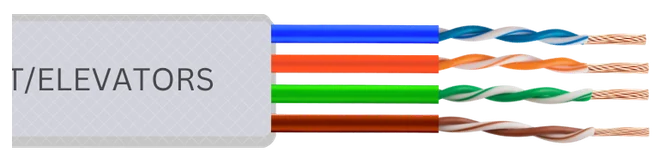
- A flat profile, so the cable hangs in one plane, bends across its thin axis only, and does not twist around the lift's own travelling cable.
That is the whole idea behind CAT6Flat. Nothing exotic: the same electrical behaviour as CAT6 for the camera, built in a form that survives the journey.
A fair warning
A flat stranded cable has slightly higher resistance than a solid one, so the recommended run for an IP camera on PoE is up to 60 m. In a lift that is rarely a limit, because the loop is short. The calculator works out the length from the travel height.
If your lift camera is already misbehaving, the six-question diagnosis will tell you where to look first.