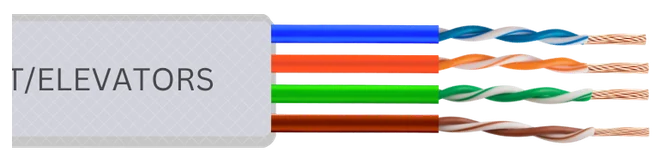
Seven myths about lift camera cable
Things installers say in good faith, and what actually happens in the lift well.
None of these are said in bad faith. Each one is something a sensible installer believes because it is true on a wall, in a ceiling, or in a conduit. A lift well is a different environment, and the rules change when the cable moves.
Myth 1: Any CAT6 will do. It worked on the day.
It will work on the day, and for some time after. Solid-core CAT6 is made to be installed once. Under repeated flexing the copper work-hardens at the bend and can crack, and the fault then shows only when the cabin moves. Use a flat stranded travelling cable for the moving section. Round CAT6 is right for the fixed run from the NVR to the junction box.
Myth 2: Flat cable is flat cable.
A flat patch cable is a thin desk cable with no flex rating and no flame-retardant jacket. A CAT6 flat lift cable is a travelling cable: stranded conductors, a flexible FRLS jacket, built for continuous movement. They look alike and behave nothing alike. Ask for the part code and the datasheet.
Myth 3: Thicker means tougher.
A stiff, thick jacket resists bending, and a cable that resists bending in a loop that must bend every trip is under more stress, not less. What matters is a soft jacket and a bend radius the cable is designed for: for CC-8251G-90, 12 × 5 mm in section, bending across its thin axis.
Myth 4: Leave the spare coiled on the cabin top, just in case.
A coil on the cabin top flexes on every trip, so the spare is the first part to fail. Cut the cable to length and leave a short service loop before it enters the cabin.
Myth 5: Tape it to the lift's own travelling cable so they move together.
Lay it beside the lift's travelling cable, same side and same plane, with the loop hanging free, but do not tape it. Taping couples the camera cable to the lift's power and control cable, which invites drive noise into the picture. Keep a few centimetres between them.
Myth 6: A well-made joint in the loop is fine.
A coupler, splice or junction box inside the moving section adds contact surfaces that loosen under vibration and flexing. Every joint belongs in the junction box in the fixed section, never in the loop.
Myth 7: PoE reaches 100 m, so the flat cable can run 100 m.
The 100 m figure is for solid CAT6 in a fixed installation. Stranded 24 AWG has higher resistance than solid 23 AWG, so the recommended run for an IP camera on PoE over CC-8251G-90 is up to 60 m. In a lift the loop is usually well inside that. If the sums say it is not, move the fixing point nearer mid-travel.
Where to go next
Flat vs round, with the numbers · How to install it · Printable acceptance test sheet