
IP camera in a lift
An IP camera in a lift car connects to the building's NVR or switch like any other camera — over four twisted pairs, with power over Ethernet on the same cable. The only thing that is different is the cable itself: it travels with the car, so it must flex millions of times without the conductors fatiguing. That rules out ordinary round CAT6 and points to a flat, stranded, FRLS travelling cable.
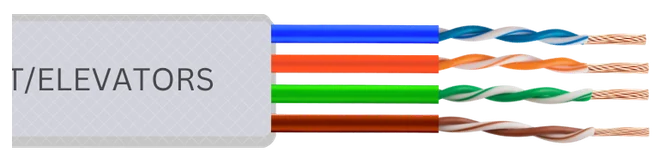 CAT6 Flat 4 Pair lift cableCC-8251G-90 · 90 m coil pairs
IP camera on PoE: recommended run up to 60 m.
Alternative: CAT6 Flat — 4 Pair + GI Rope · CC-8261G-90The cable
Use CC-8251G-90, the CAT6 Flat 4 Pair. It is a 12 × 5 mm flat cable with four pairs of 24 AWG stranded copper (7/0.195 mm), each pair in its own flexible PVC sheath, inside an FRLS PVC outer. It meets the CAT6 electrical values in the datasheet — 100 ± 15 Ω impedance, ≤ 45 ns delay skew, IEC 60332-1 fire performance — and is recommended for runs up to 60 m. For tall shafts or lifts that run all day, the same cable is available with two galvanised steel messenger ropes as CC-8261G-90.
How far
Sixty metres of cable is the recommended maximum for a PoE camera on this cable. In practice that covers the loop in most buildings up to roughly 20 floors: the cable hangs from a fixing point near the middle of the shaft, so the cable length is about half the travel plus the drop into the car plus loop allowance. Use the calculator on the Choose page to turn shaft height into cable length and coil pairs.
PoE budget
A standard 802.3af (15.4 W) or 802.3at (30 W) switch port will power a typical lift-car camera comfortably over 60 m of 24 AWG stranded copper. If the camera has a heater, an IR array or a built-in intercom, check its power draw against the switch's per-port budget and keep the run short. Do not extend the cable with a coupler inside the shaft; every joint in a moving loop is a future fault.
Termination
Stranded conductors need RJ45 plugs specified for stranded wire (or pass-through plugs with the correct contacts). Plugs made for solid core bite into a stranded conductor and work loose with vibration. At the car end, leave a short service loop and secure the cable to the car-top frame with a cushioned clamp, not a cable tie pulled tight.
Routing
Hang the camera cable alongside the lift's own travelling cable from the same bracket, with its own clamps, and keep it clear of the counterweight path. Do not tape it to the power travelling cable; twisted pairs reject most drive noise, but a few centimetres of separation costs nothing and removes the argument later.
IP camera in a lift — questions
Can I use normal CAT6 for a lift camera?
Not for the travelling section. Round CAT6 has solid conductors and a stiff jacket; it survives being pulled once, not flexing on every trip. Installers who try it typically replace it within a year. Use a flat, stranded travelling cable in the shaft and ordinary CAT6 from the machine room to the NVR.
Which cable for an IP camera in a lift in India?
Channeltech CC-8251G-90, CAT6 Flat 4 Pair — a flat FRLS PVC travelling cable with stranded copper pairs, 90 m coil pairs, recommended for IP-camera runs up to 60 m. For tall shafts, CC-8261G-90 adds GI messenger ropes.
Does the lift company have to install it?
In most buildings the lift AMC company controls access to the shaft and the car top, and will insist on doing or supervising the fixing. Bring the coil, the clamps and the cable data; they bring the shaft access and the safety procedure.
Wireless or cable?
Wireless bridges work in some shafts and fail in others as the car passes steel; they also need power in the car anyway. A cable is the reliable option, and CAT6 flat carries the power too.
Size it with us
Lifts, travel height, camera type — we reply with the cable, the coil pairs and delivery.