
Tall and heavy-duty shafts: the GI rope version
A travelling cable hangs from a fixing point and swings with every trip. In a low-rise building the loop is short and the cable's own construction carries the weight comfortably. Above roughly 15 floors, or in a lift that runs continuously, the hanging weight and the number of flex cycles both climb — and the conductors should not be the thing holding the cable up.
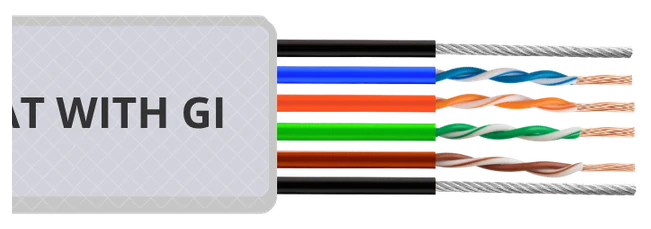 CAT6 Flat 4 Pair + GI Rope lift cableCC-8261G-90 · 90 m coil pairs
IP camera on PoE: same electrical construction as CC-8251G — recommended run up to 60 m.
Alternative: CAT6 Flat — 4 Pair · CC-8251G-90The cable
Use CC-8261G-90, the CAT6 Flat 4 Pair with two multi-strand galvanised steel (GI) ropes moulded into the flat profile. The ropes are terminated at the bracket with rope clamps and take the load; the four copper pairs — the same construction as CC-8251G-90 — carry only the signal.
When it is needed
Use the GI rope version when the lift company already uses a rope-supported travelling cable, when the shaft is above about 15 floors, when the lift is in continuous service (hospitals, offices, malls), or when the site is exposed to vibration. In a short shaft it is over-specified; CC-8251G-90 is enough.
Fixing
Clamp the ropes, not the cable body, at the bracket. Leave the loop free to swing, and check the clamps at the first service visit — the ropes settle slightly under load.
Tall and heavy-duty shafts: the GI rope version — questions
What is a GI rope in a lift cable?
A galvanised steel wire rope moulded into the cable as a messenger: it carries the cable's hanging weight so the copper conductors are not under tension. Channeltech CC-8261G-90 has two of them.
Does the GI rope change the electrical performance?
No. The four pairs are the same as CC-8251G-90; the 60 m recommended run for IP cameras still applies.
Size it with us
Lifts, travel height, camera type — we reply with the cable, the coil pairs and delivery.