What is a CAT6 flat lift cable? Travelling cable, FRLS, GI rope and 2+2 explained
The terms you will meet when specifying a camera or intercom cable for a lift, defined in one sentence each.
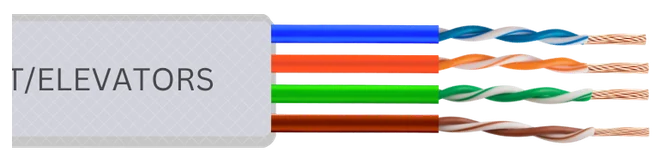
A CAT6 flat lift cable is a flat, flexible Ethernet cable built to hang and flex inside a lift shaft. It uses stranded (multi-strand) copper conductors instead of solid ones, a soft flame-retardant low-smoke jacket instead of a rigid one, and a flat profile so that it hangs without twisting. It carries the data — and, over PoE, the power — for an IP camera in the lift car.
Travelling cable
A travelling cable is any cable that moves with the lift car. The lift's own travelling cable carries the car's power, lighting and control signals; a camera or intercom cable is an additional travelling cable, normally hung from the same bracket. Travelling cables are covered by standards such as EN 50214 (flat PVC-sheathed lift cables), which is why flat profiles are the norm.
Why flat
A flat cable hangs in a predictable plane, does not twist as the car moves, and bends only across its thin axis. Channeltech's CAT6 Flat 4 Pair is 12 mm wide and 5 mm thick and bends to a radius of four times its thickness. A round cable of the same conductor count would twist in the loop and bend unpredictably.
Stranded versus solid conductors
Solid-core CAT6 (23 AWG, one copper wire per conductor) is made for cables that are pulled once and left alone. Under repeated flexing the solid wire work-hardens and cracks. A lift cable uses stranded conductors — in CC-8251G-90, seven strands of 0.195 mm copper per conductor (24 AWG) — which share the bending between strands and last for millions of cycles.
FRLS
FRLS stands for flame retardant, low smoke. An FRLS PVC jacket resists spreading a flame along the cable and produces less smoke when it burns, which matters in a shaft that acts as a chimney through the building. Channeltech's flat lift cables are FRLS and the CAT6 Flat 4 Pair meets the IEC 60332-1 single-cable flame test.
GI rope (messenger)
A GI rope is a galvanised steel wire rope moulded into the cable to carry its hanging weight. Without it, a long loop hangs from its own conductors. Channeltech CC-8261G-90 has two GI ropes in the flat profile; it is used for tall shafts and continuously running lifts.
2+2 flat
A 2+2 flat cable carries two coaxial video cores and two power cores in one flat jacket, for HD-TVI, AHD, HD-CVI and analog cameras that connect to a DVR. Channeltech CC-9511K-90 uses tinned-copper video cores and copper power cores.
PoE in a lift
Power over Ethernet sends DC power to the camera over the same pairs as the data. On CC-8251G-90 Channeltech recommends runs up to 60 m for an IP camera on PoE, which keeps the voltage at the camera within range on a standard 802.3af/at switch port.
Coil pairs
Lift cables are supplied in matched coil pairs — 90 m + 90 m — because a lift job consumes cable in pairs (two lifts in a shaft group, or the run and its spare). Order by the number of coil pairs, not metres.